
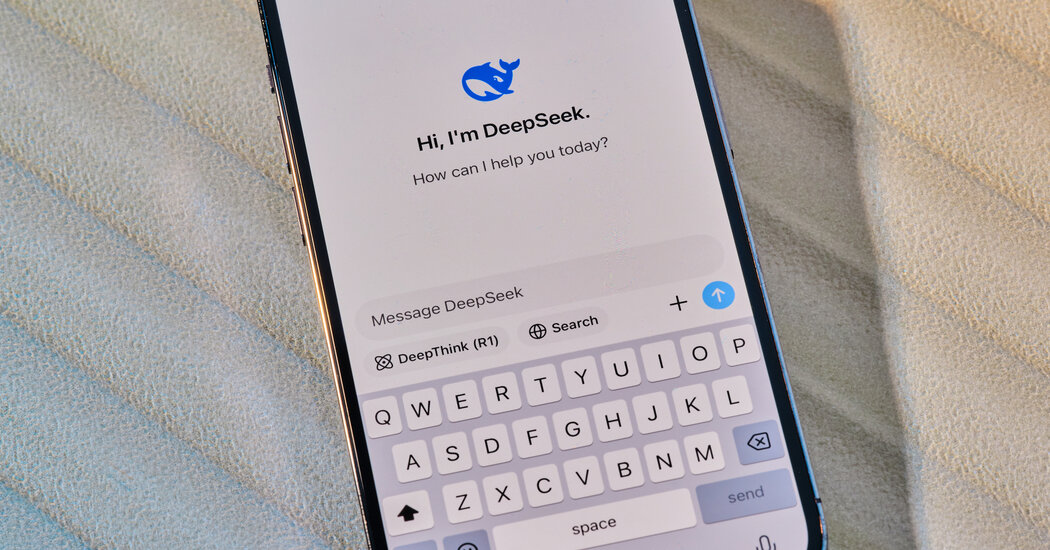
When the Chinese start-up DeepSeek published details about one of its artificial intelligence models last year, it sent shock waves through the tech industry.
The company said it had built its system by spending far less on computer chips than American rivals like OpenAI and Anthropic. It marked the start of what became known as China’s “DeepSeek moment,” shorthand for the belief that Chinese A.I. companies were ready to showcase their technical capabilities to the world.
The DeepSeek moment reflected a shift in the global A.I. landscape. The change was not only about lower costs, but also openness in how the technology is shared.
DeepSeek released its models as open source, which means others can freely use and modify them. By contrast, OpenAI and Anthropic kept their leading models proprietary. The episode demonstrated that an open-source system could perform almost as well as closed versions. In the months that followed, Chinese firms released dozens of other open-source models. By the end of 2025, these models made up a significant share of global A.I. usage.
On Friday, DeepSeek released a preview of V4, its long-awaited follow-up model, which it intends to open source. The new model excels at writing computer code, an increasingly important skill for leading A.I. systems. It significantly outperformed every other open-source system at generating code, according to tests from Vals AI, a company that tracks the performance of A.I. technologies.
DeepSeek released its new model just days after Moonshot AI, another Chinese start-up, introduced its latest open-source model, Kimi 2.6. While these systems trail the coding capabilities of the leading U.S. models from Anthropic and OpenAI, the gap is narrowing.
The implications are meaningful. Using A.I. to write code is faster and frees up human programmers to focus on bigger issues. It also means people can use DeepSeek’s latest release to power A.I. agents, which are personal digital assistants that can use other software applications on behalf of office workers, including spreadsheets, online calendars and email services.
As A.I. systems improve at writing computer code, they are also getting better at finding security vulnerabilities in software — a skill that is fundamentally changing cybersecurity. That means tools like DeepSeek’s can be used to both attack and defend computer networks.
Across tasks, DeepSeek V4 is on par with Moonshot’s latest model. “They are basically neck-and-neck,” said Rayan Krishnan, the chief executive of Vals AI.
In the months leading up to DeepSeek’s latest release, foreign rivals moved to pre-empt another round of glowing headlines. Silicon Valley’s A.I. giants, Anthropic and OpenAI, said DeepSeek had unfairly piggybacked on their technology through distillation, a process in which engineers mimic a rival model by querying it millions of times and copying its behavior.
The competition to build the best-performing A.I. systems has transformed into a geopolitical power struggle. While Silicon Valley leaders at Anthropic and OpenAI warn that their technology would be dangerous in the hands of autocratic countries, China has invested billions to become an A.I. superpower, viewing the technology as a critical engine of economic growth.
DeepSeek’s open-source models are central to this strategy. While many Western companies guard their most valuable models, China has embraced open source and almost all of its top-performing systems are widely available.
Even so, Chinese A.I. firms face major hurdles. Three U.S. administrations have imposed export controls limiting access to advanced chips needed for cutting-edge A.I. systems. And firms in Silicon Valley continue to outspend Chinese rivals in the race for top A.I. talent.
China’s push into open-source A.I. has become a major economic advantage at home, according to a new study by a U.S. congressional advisory body. With few barriers to use, the systems have spread across industries such as robotics, logistics and manufacturing. The study found that these industrial applications generate real-world data that are used to improve A.I. systems.
This approach has allowed Chinese tech firms to capture global influence, as programmers and engineers around the world adopt their systems to build new products.
From Lagos to Kuala Lumpur, developers on tight budgets are turning to Chinese open-source models because they are cheaper to run and therefore easier to experiment with. Last May, Malaysia’s deputy minister of communications said the country’s sovereign A.I. infrastructure would be built on DeepSeek’s technology.
Chinese open-source models accounted for roughly one-third of global A.I. usage last year, according to a study by OpenRouter, an A.I. model marketplace. DeepSeek was the most widely used, followed by models from Alibaba, the Chinese internet company.
That reflects a broader strategy. As Chinese companies expand abroad, making their systems open-source helps them gain traction with coders by offering cheaper, more accessible tools.
“Open source is the soft power of technology of the future,” said Kevin Xu, the U.S.-based founder of Interconnected Capital, a hedge fund that invests in artificial intelligence technologies. Mr. Xu and his fund do not invest in DeepSeek.
Wei Sun, a principal analyst in A.I. at Counterpoint Research in Beijing, said DeepSeek’s success paved the way for China’s tech giants to release their A.I. systems publicly rather than closely guarding them.
Alibaba has since emerged as a leader. Its Qwen model family has surpassed 1 billion downloads. ByteDance, parent company of TikTok, has also shared some details of its technology after spending $11 billion on A.I. infrastructure in 2024.
“The A.I. generation of open-source builders from China was arguably the biggest A.I. story in 2025,” Mr. Xu said. “The progress of the models, the pace of the releases, and the number of A.I. labs that both compete with each other but also seem to cheer each other on came fast and furious with no signs of slowing down.”