
Electric vehicle sales have been slumping since September, when federal tax credits of up to $7,500 ended under a law championed by President Trump.
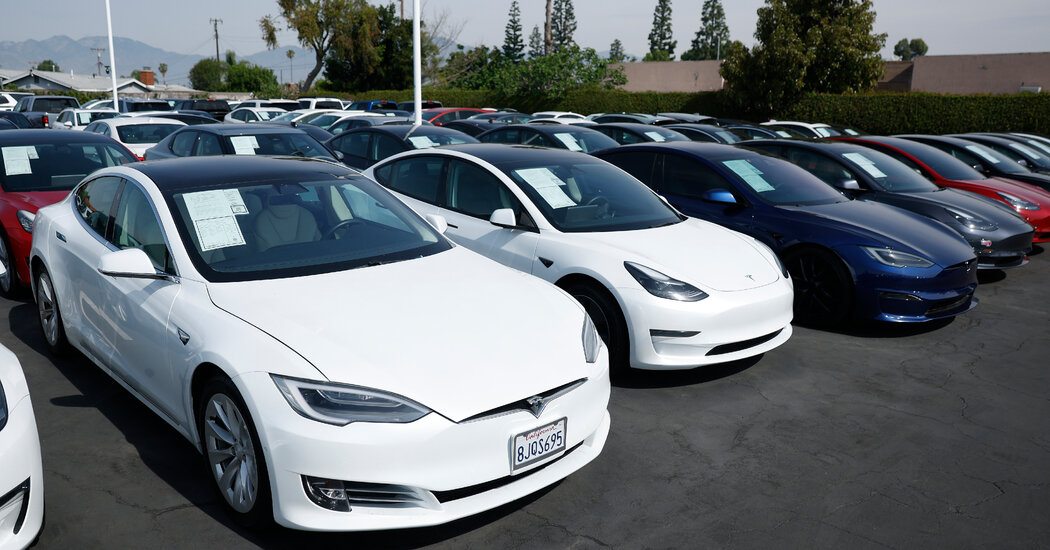
But the business of selling battery-powered cars is about to get something of a boost from waves of slightly used models that will be rolling onto dealer lots over the next three years.
Leases on some 300,000 two- and three-year-old electric vehicles will expire this year, up from just 123,000 in 2025, and many of those cars will return to the market as used cars. They will be followed by 600,000 in 2027 and nearly 660,000 in 2028, according to Cox Automotive, a market research firm.
The sudden influx is giving consumers affordable electric vehicle options when gasoline prices have surged past $4 a gallon and new-vehicle prices are near a record.
“These off-lease vehicles will increase consideration for E.V.s for a lot of used-car shoppers,” Stephanie Valdez Streaty, Cox’s director of insights, said. “A big reason a lot of consumers have stayed away from new E.V.s is the price. But these used vehicles offer a much better value proposition. And with higher gas prices, people are willing to give them a look.”
The great lease return could also provide a lift to sales and leases of new electric vehicles because many of the people giving up these cars will be looking for new rides. Some surveys have found that a large majority of people who drive electric cars say they would pick another one for their next vehicle.
But the biggest effect will be on used cars, which are bought by vastly more Americans than new cars.
Vic Spanos, owner of Spanos Motors, an upscale used-car dealership in Daytona Beach, Fla., is seeing it already.
“Right now, we’re getting more leads for electric cars than regular cars,” he said. “Our customers tend to be middle to upper class, and they are seeing the value in used electric cars, as second cars, as cars for kids in college.”
The wave of used electric vehicles is the product of the Inflation Reduction Act, President Joseph R. Biden Jr.’s signature climate and energy law. Under the 2022 law, purchased vehicles qualified for the full $7,500 credit only if they were assembled in North America and met other conditions. But all electric vehicles were eligible for the $7,500 credit if they were leased.
The credit on leased vehicles went to financing arms of automakers, which generally passed those savings on to consumers to increase demand. In some cases, automakers were offering leases with monthly payments as low as $199 for cars that normally would cost substantially more.
As a result, many car buyers opted to lease rather than buy. In 2022, leases accounted for about 15 percent of all new electric vehicle transactions, according to CDK Global, a provider of software and data services for auto dealerships. In 2025, that figure climbed to more than 60 percent.
Mr. Trump’s One Big Beautiful Bill ended the tax credits on Sept. 30, upending the market for electric cars.
In the last three months of 2025, sales and leases of new electric vehicles fell 36 percent from the same period in 2024. They then dropped 27 percent in the first quarter of this year.
Amid the turmoil, values on used electric vehicles have sunk. In 2023, leased electric vehicles were generally expected to be worth about 60 percent of their original price after three years on the road. Instead, three-year-old models are worth about 45 percent, and sometimes less.
In Downers Grove, Ill., about 23 miles west of Chicago, Castle Volkswagen is offering a formerly leased ID.4 Pro S model, with 33,000 miles on the odometer, for less than $23,000. That model cost about $52,000 when it was new in 2023.
AutoNation, a large dealership chain, is advertising a 2023 Hyundai Ioniq 5 sport utility vehicle for $28,000. It has been driven only 18,000 miles. Loaded with options including all-wheel drive and a panoramic roof, it was listed at $58,000 three years ago.
Teslas have also declined in value but have done better than cars from other brands. AutoNation is also offering a Tesla Model Y with all-wheel drive and a long-range battery for $34,000 — about 60 percent of its original price.
And while new electric models are typically more expensive than comparable gasoline vehicles, used versions are priced similarly, said Dave Thomas, CDK Global’s direct of content marketing.
“Used E.V.s tend to have low miles and a lot of technology and luxury features,” he said. “So what shoppers are finding is that these cars coming off lease are a really strong value proposition.”
Car buyers seem to be noticing. Ms. Valdez Streaty said sales of used electric vehicles rose 20 percent in the first quarter, to more than 100,000 vehicles.
But the impending end of all these leases will not be good for everyone.
The finance divisions of car companies that own those leased cars may now have to take big losses on vehicles that are not worth as much as they estimated when leases were signed two or three years ago.
For example, an automaker may have estimated that a $70,000 car it leased to someone in 2023 for three years would be worth $45,000 — a figure known as the car’s residual value — in 2026 when it was returned. That car company will have to book a loss of $10,000 if the car sells for $35,000.
“That’s the negative in all this,” Mr. Thomas said. “It definitely hurts the financial companies.”
Automakers typically sell returned lease cars to their dealers or to wholesale auctions, where any car dealer can buy them. The dealers then sell the cars to individuals for a higher price.
Mr. Spanos, the Florida dealer, sees a big, new opportunity in used electric vehicles because prices have fallen so much. Dealers also tend to make a lot more money on used cars because automakers play a big role in determining how much new vehicles sell for by offering discounts and other incentives to lure buyers.
Mr. Spanos, who started his business 30 years ago with his brother, has about 90 vehicles in stock, and only seven or eight are electric. But over the coming months, he aims to have electric models make up about half his inventory.
“There’s more activity in the E.V. space,” he said. “Because now you can get one without paying a premium.”
He may even add a nearly new Tesla Cybertruck. In February, Tesla temporarily dropped the price of a certain version of the angular pickup by $20,000 for 10 days, and Mr. Spanos ordered one without knowing whether he would drive it himself or sell it to a customer or in a wholesale auction.
“For me, it made sense with that discount,” he said. “Worst case, I can sell it at the auction and make money.”