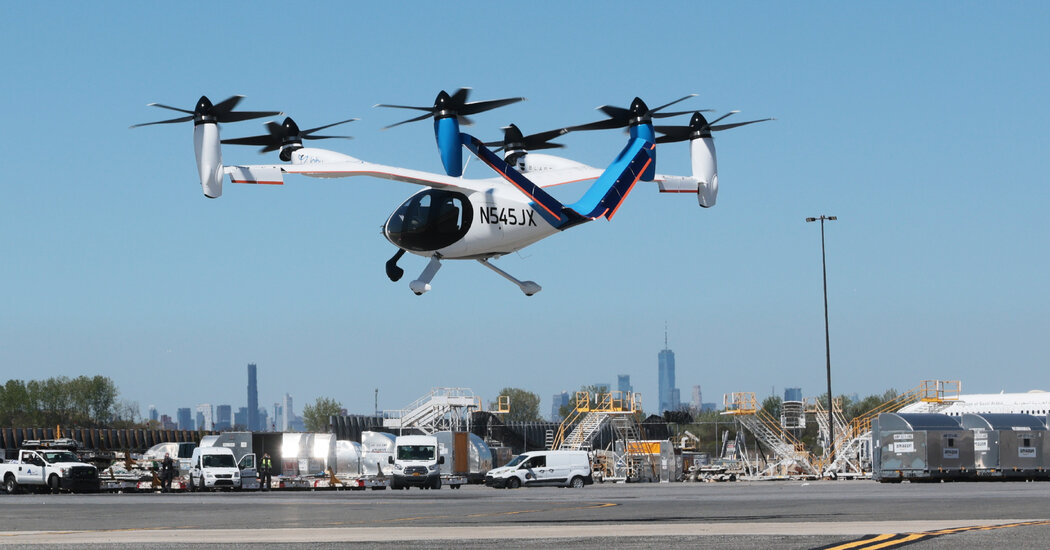
Under a clear blue sky, a new kind of electric aircraft flew from Kennedy International Airport into the heart of Manhattan this April. The trip took around 10 minutes, a fraction of the hour or more it could take in a car.
The flight offered a glimpse at how the aircraft, which is made by Joby Aviation and combines features of a helicopter and an airplane, and others like it could someday operate in cities. It was made possible by a federal program that is trying to hasten the arrival of what are often called air taxis.
The companies that make the new electric aircraft and some industry experts say air taxis will someday replace helicopters and maybe even cars for some uses. But some skeptical experts say the aircraft will be more expensive than helicopters and have relatively limited uses, noting that the industry has promised commercial flights for years but that no company has secured federal approval to routinely carry passengers or cargo in the United States.
“It’s not going to be like we look out our window and there’s flying cars everywhere,” said Laurie Garrow, an engineering professor at the Georgia Institute of Technology who focuses on aviation. “I think we are, in the next two to five years, looking at these aircraft entering into service and filling these niche markets to begin with.”
The Trump administration has been so eager to usher in that era that it created a program last year to encourage states, cities and companies to work together to help roll out electric aircraft for passenger, cargo and medical operations.
In March, the Transportation Department selected eight projects across 26 states, including the one that allowed for Joby’s pilot-only demonstration flight in New York.
One central aim of the administration’s efforts is ensuring that the United States doesn’t fall behind China, which leads the world in commercial drones and is also developing air taxis; at least one company there has received limited authority for commercial flights using a pilotless aircraft. The United Arab Emirates has also been preparing for commercial air taxi flights in partnership with Joby and a rival manufacturer, Archer Aviation.
“The U.S. still has the scars of the 2000s, where it abdicated the entire drone market to China,” said Sergio Cecutta, an aerospace consultant. “The whole idea with this push from Washington is to make sure that this doesn’t happen again.”
The federal program allows limited operations, including some commercial flights, which the air taxi companies say will help them gain flight experience and collect data. It also allows local government officials and residents to get more comfortable with the technology.
But air taxi companies cannot begin regular commercial flights until the Federal Aviation Administration certifies the aircraft after rigorous tests. It is not clear how soon the agency will certify its first air taxi.
There are three leading U.S. electric aviation companies: Joby, Archer and Beta Technologies. All three are developing aircraft that can take off and land like helicopters and move through the air like planes, while Beta is also developing a version that flies only like a plane, which it plans to bring to market first. A Boeing subsidiary, Wisk Aero, is also developing an air taxi, but that aircraft will be certified later, experts said, because it is expected to fly autonomously.
Toyota is a major investor in Joby and providing it with manufacturing expertise. Archer has a similar partnership with Stellantis, the parent company of Fiat, Jeep and Ram. And GE Aerospace has invested in and is working on technology with Beta.
The Joby demonstration flight departed from Kennedy before noon on April 27. It landed minutes later at the West 30th Street Heliport, a short walk from Penn Station. The helipad is often used by Blade, which connects cities to airports around the world with conventional helicopters. Blade sold its passenger business last year to Joby, which plans to eventually replace Blade’s helicopters with its own aircraft.
The most likely use of air taxis, which can generally fly short distances before needing to be recharged, is as a replacement for helicopters, which are noisy and relatively hard to maintain, experts said. In the more distant future, rich people may use electric aircraft as a replacement for chauffeured cars.
How widely the aircraft are used will depend primarily on how much they cost to make, operate and maintain. Aviation experts are deeply divided on how that math will work out.
Most analysts agree that air taxis will be expensive to produce at first. According to some experts, the aircraft could cost up to $5 million in the early days, as much as or more than a helicopter that can carry more passengers, travel farther and be refueled more easily. Production may also be difficult to speed up because air taxis use light and strong carbon composites, which are more expensive and difficult to make than the aluminum, titanium, steel and other metals traditionally used for helicopters.
“It’s this huge speed bump for the production,” said Bjorn Fehrm, an aeronautical and economic analyst with Leeham, an aerospace consulting firm.
Most experts say air taxis should have lower operating costs than helicopters, particularly if they fly often. The newer aircraft won’t rely on expensive jet fuel and complicated mechanical components. As air taxi companies build more aircraft, their executives say, the cost of each one will fall.
“The first thing is you want to scale it out, and then the unit economics will fall in line,” Joby’s founder and chief executive, JoeBen Bevirt, said in an interview beside Joby’s aircraft after it landed in Manhattan in April.
But some experts say the intense power required to take off and land will strain the aircraft’s batteries, potentially requiring frequent maintenance or replacement. They also say air taxis may not fly as often as their makers expect because they will be limited by weather conditions, local regulations, pilot availability and other issues.
There will be other challenges. High-powered chargers will be needed at airports, heliports or anywhere else an air taxi may land. In a report released last week, the Government Accountability Office said one airport estimated that the cost of providing charging infrastructure at one location could cost about $2 million.
Eric Lentell, Archer’s chief legal and strategy officer, said the industry was improving its technology and production methods to reduce costs, not unlike Tesla after it introduced its first model, the two-door Roadster sports car.
“If you look back at that Roadster, you’d be like, ‘That wasn’t a viable product in today’s market,’” he said.
But the biggest hurdle will be certification.
New versions of existing jets produced by Boeing and Airbus can take many months or even years to win approval from the F.A.A. and its European counterpart. A completely new kind of plane could take longer. Aviation experts say regulators are likely to be even more cautious than they have been in the past because Boeing’s 737 Max had two accidents in which everybody onboard was killed. Those crashes, in 2018 and 2019, occurred just a few years after the jet was certified.
Joby, Archer and Beta have each made progress with the F.A.A. None has said it has begun certification flight testing with pilots employed by the agency, an important step, though Joby says it expects to start those flights this year.